
Last Updated: 31 August 2026
When people connect devices to a network, they rarely think about how communication actually happens. However, the flow of data is regulated by an IP address behind every connection. The class C IP address is among various classes that have a powerful role in regular networking, particularly in homes and in small businesses. Throughout this article, you will delve into the mechanism behind IP addressing, the distinction of this category, and the reasons as to why it remains relevant. Besides, you will learn its architecture, functions, and real-life implementation in practice. Further, the concepts will be described in a simple and linked fashion, which even the new entrants can easily follow.
What is a Class C IP Address?
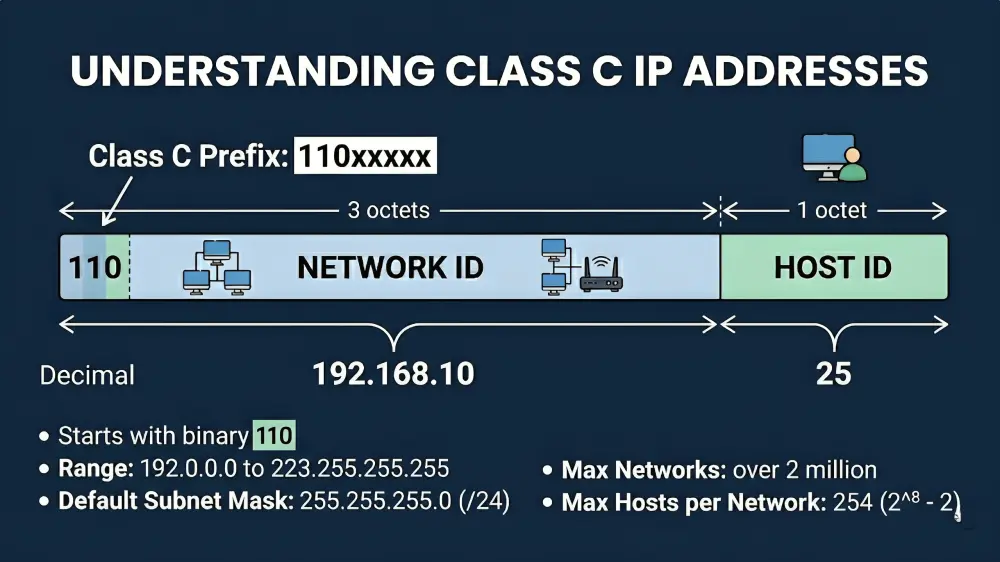
A class C IP address belongs to a specific category within IPv4 that supports smaller networks with limited devices. It works with 192.0.0.0 to 223.255.255.255, which is only appropriate in settings that do not demand a very high level of scalability. In turn, it provides a middle ground between performance and simplicity.
The format of this type of address orderly breaks down the network component and the host component. The network is determined by the first three numbers and the device by the final number. Due to this design, network administrators are able to easily administer systems without complicated designs.
| Component | Example | Role in Network |
| Network Section | 192.168.1 | Identifies network |
| Device Section | 10 | Identifies device |
Moreover, the default subnet mask in this case is 255.255.255.0, and this makes it easier to partition the network and host segments. Hence, such explicit isolation contributes to the upkeep of order in the network. The consequence is that a class C IP address is the preferred choice among home routers, small offices, and educational labs.
Understanding the Basics of IP Addressing in Networking Systems
The IP addressing is the basis of the digital communication system, as each device requires its own identity to communicate in a system. An IP address acts like a geographical name, which enables the data to be passed between different devices and not get lost. Thus, by opening a web page or transferring files, a user permits the system to build on this addressing scheme to accomplish it effortlessly.
IP addressing has two major versions, namely IPv4 and IPv6. However, IPv4 remains more prevalent in the local networks. In IPv4, the addresses are composed of four digits divided by dots, e.g., 192.168.1.1. Such numbers are categorized into classes and determine the organizational structure of the network and the number of devices it can support. Consequently, the knowledge of these classes is useful in the administration of the network design.
| IP Type | Structure Example | Purpose |
| IPv4 | 192.168.1.1 | Common network communication |
| IPv6 | 2001:db8::1 | Advanced and large-scale networks |
Due to such a system of classification, networks are able to expand as needed. Other classes may cause large enterprises to work with large sets, but small setups can boast of simplified setups. Here is where the class C IP address comes in handy and is a common usage.
Key Features of Class C IP Addresses in Modern Networking
The class C IP address offers several features that make it efficient for smaller environments. These characteristics enhance the efficiency of networks, ease of configuration, and facilitate communication between the devices. Therefore, the knowledge of these characteristics enables users to select the appropriate setting depending on their requirements.
Limited Device Support:
The most defining feature of this IP class is its limited capacity. Each network can handle up to 254 usable devices, since two addresses remain reserved for network identification and broadcasting. Because of this limit, it works best in environments where device numbers remain controlled.
| Category | Count |
| Total Addresses | 256 |
| Usable Devices | 254 |
| Reserved | 2 |
Although the number may seem small, it perfectly fits small offices, homes, and classrooms. Therefore, instead of overcomplicating the setup, it keeps things manageable and efficient.
Subnetting Possibilities:
Subnetting enables networks to be broken into smaller parts so that the networks can be controlled and labeled easily. Using a Class C IP address, administrators will be able to set up several sub-networks using the same range. This then enhances security and alleviates traffic congestion.
An example of this is a business may designate various subnets to various departments like HR, IT, and Sales. This segregation ensures the elimination of redundancy of data and also boosts performance. In addition, it aids in isolating pertinent problems in cases where troubleshooting is needed.
Common Usage:
This type of IP is commonplace in cable Networking since it is easy and convenient. The addresses of the home routers are in this category, such as 192.168.x.x. Thus, people use this system without even being aware of it.
Typical settings are residential networks, small businesses, and academic institutions. Such networks are still easy to set up, as even novice users would be able to operate them. Consequently, the class C IP address has continued to be one of the most viable options for limited-scale connectivity.
Types of Class C IP Addresses in Real Use
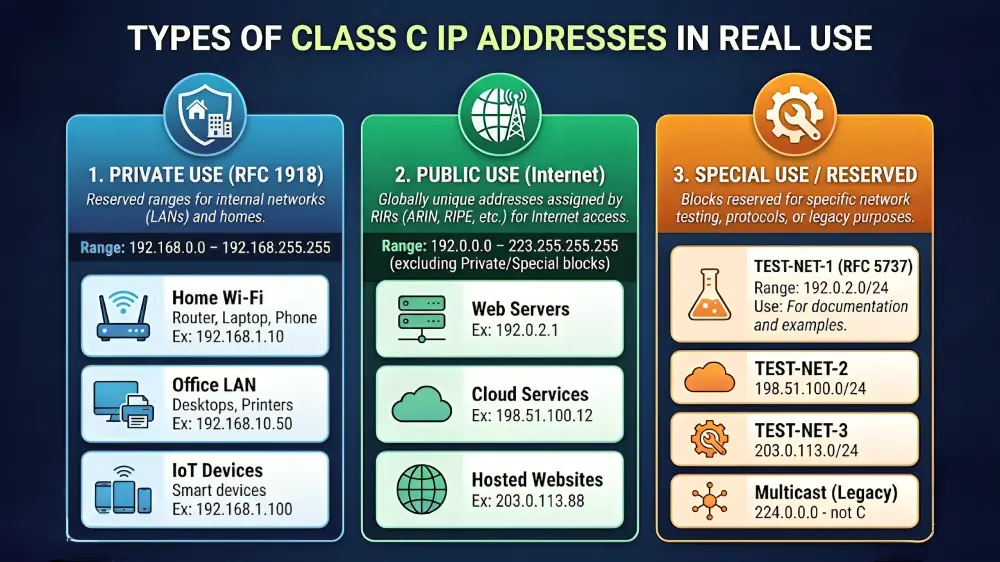
A class C IP address usually appears in everyday networking, especially in homes and small offices. When working with these addresses, though, users may encounter different formats, improper entries, and sometimes create errors. Thus, the knowledge of these variations prevents misunderstandings of the topic as well as enhances the practical level of knowledge. Each type is discussed in the sections below in a way that is easy to understand, with simple examples, in order to know the valid and invalid formats easily.
1. Standard Private Class C IP Address Format
A standard private class C IP address follows the IPv4 format with four octets separated by dots. The octets are kept within 0 to 255, thus facilitating correct communication in a network. Home routers generally give these addresses automatically, and as a result, they are very widespread in our everyday lives. In addition, these are the addresses of the personal domain, and thus, they cannot be viewed directly on the internet. Due to this, they offer a safe and secure networking space.
Example:
An address, such as 192.168.1.100 or 192.168.1.3 is correctly formatted and is within the appropriate range. Routers provide these addresses to devices like laptops and phones in real-world situations.
2. Default Gateway and Router-Based Class C Addresses
Routers usually have a fixed IP to be a gateway between equipment and the internet. This gateway is typically part of the class C IP address range and can not be varied unless manually. Due to this, users are able to gain access to router settings via a browser using such an IP. Moreover, it is due to this address that traffic in networks is handled.
Example:
Addresses like 192.168.1.1, 192.168.7.1, or 192.168.4.1 are commonly used as default gateways. These can enable users to easily set up Wi-Fi settings, passwords, and security.
3. Device-Specific Assigned Class C IP Addresses
All devices on a network are assigned different identifiers in the same range. This is to ensure that data will reach the right destination without duplication. As all the devices should have different identities, routers can provide various numbers in the final octet. Thus, communication is well-structured.
Example:
Devices may receive addresses such as 192.168.1.2, 192.168.1.6, or 192.168.1.250. These are personal devices such as smartphones, printers, or computers which are connected to a single network.
4. Alternate Private Range Variations Within Class C
Sometimes networks use slightly different ranges within the same private category. Even though they continue to be Class C, the third octet is different, such that new sub-networks are formed. That is why this strategy assists in breaking up big structures into small, manageable teams. Moreover, it enhances the performance of the network through the minimization of congestion.
Example:
Addresses like 192.168.11.1, 192.168.0.254, or 192.168.4.1 show variation in the third octet. These are still valid and commonly used in segmented networks.
5. Incorrectly Formatted Class C IP Addresses
When users are typing in IP addresses, they tend to make typing errors, resulting in invalid formats. As every octet has to remain within the range of 0-255 and there has to be a separation in between dots, any alterations will render the address useless. Consequently, these mistakes can be identified to avoid configuration problems.
Example:
Entries like 192.168.1001 or 192.168 l 1.11 are incorrect because they break format rules. Similarly, 192.168 l 254.254 contains spacing errors, which makes it invalid.
6. Link-Local and Special Purpose Addresses Related to Class C
There are also some appearances that closely resemble those of Class C, yet their applications are different. An example is link-local addresses, which aid devices in communicating in the absence of a DHCP server. Even though they are not technically a part of Class C, they tend to be confused with this because of similar patterns. Thus, knowledge of their role helps them not to be misunderstood.
Example:
An address like 169.254 belongs to link-local addressing and appears when automatic configuration happens. Meanwhile, 196.192.73.13 falls outside the Class C private range and represents a different category.
Overview of Provided Class C IP Address Examples
The table below summarizes all the given IP formats, including valid, invalid, and special cases. This helps you quickly identify their type and usage.
| IP Address | Type / Category | Explanation |
| 192.168.l.2 | Invalid Format | Contains letter instead of number |
| 192.168.1.100 | Valid Class C | Standard private IP |
| 192.168.11.1 | Valid Class C | Subnet variation |
| 192.168.1001 | Invalid Format | Octet exceeds limit |
| 169.254 | Link-Local | Auto-assigned IP |
| 192.168.4.1 | Gateway / Valid | Router IP |
| 192.168.4.1 | Gateway / Valid | Duplicate valid entry |
| 192.168.1.3 | Valid Class C | Device IP |
| 192.168.7.1 | Gateway / Valid | Router IP |
| 192.168 l 1.11 | Invalid Format | Contains spacing error |
| 192.168.0.254 | Valid Class C | Network edge IP |
| 192.168.1.250 | Valid Class C | High-range device IP |
| 192.168 l 254.254 | Invalid Format | Incorrect spacing |
| 192.168.1.2 | Valid Class C | Device IP |
| 192.168 l 1.2 | Invalid Format | Formatting issue |
| 192.168 l 254.254 | Invalid Format | Duplicate invalid entry |
| 192.168.1.6 | Valid Class C | Device IP |
| 196.192.73.13 | Public / Non-Class C Private | Different IP range |
Why Are Class C IP Addresses Important in Small Networks?
The significance of a class C IP address is similar to the fact that it is neither too simple nor too functional. It enables networks without complex settings to be productive. Thus, it can be applied in the environment where stable performance is required, and the complexity of the technical aspects does not play a crucial role. Privacy addressing ranges are another significant advantage in enhancing security. Since there are lots of networks that operate with their own IP addresses, a few of these networks have their own IP addresses that do not have direct access via the internet. Consequently, this arrangement minimizes outsourcing risks and secures internal systems.
Also, this IP scheme eases administration and troubleshooting. The network is also smaller, meaning that devices can be easily monitored and connected by the administrators. This structure is clear and controllable, say in a small office where there are fewer than 100 devices. Additionally, it facilitates effective communication since all the devices will be addressed in a standard form. This, therefore, results in a smooth flow of data with no idle time delays. Thus, just because of modernity, the class c ip address remains very relevant in the field of networking.
Conclusion on Class C IP Address Usage and Benefits
The class C IP address continues to serve as a reliable solution for small networks due to its simplicity, clear structure, and efficient performance. It enables users to control devices with ease whilst ensuring that there is stable communication in the network.
With the advancement of technology, networking techniques can vary, but the concepts are still relevant. Consequently, the knowledge in this IP classification assists users in designing and operating networks without fear. In real-world usage, it is still one of the most available and common addressing systems that is used daily when connecting.
FAQs
1. What is a class C IP address?
It is an IPv4 address type designed for small networks with limited device capacity.
2. What range does it cover?
It ranges from 192.0.0.0 to 223.255.255.255.
3. How many devices can it support?
It supports up to 254 usable devices within one network.
4. What is the default subnet mask?
The default subnet mask is 255.255.255.0.
5. Where is it commonly used?
It is used in homes, small offices, and educational networks.
6. Why is it still relevant today?
It remains useful due to its simplicity and efficiency in small-scale networks.
7. What is subnetting in this context?
Subnetting divides a network into smaller segments for better organization and security.
Read Related Blogs: