
Last Updated: 31 August 2026
Modern networking depends on structured addressing systems that can handle scale without confusion. Among these systems, the concept of a class A IP address stands out because it was designed to support extremely large networks from the early days of the Internet. Even today, learners and professionals study it to understand how IP allocation evolved. Through this article, you will understand what a class-based system is, how to deal with it at a technical level, and why organizations still use it in controlled environments. You will also learn how such large network blocks will be practically used, the type of addresses that will be used, and the potential risks that are associated with large network blocks. Moreover, the discussion will move toward how modern systems have replaced this model while still keeping its relevance alive for learning and internal structuring.
What Is a Class A IP Address in Networking?
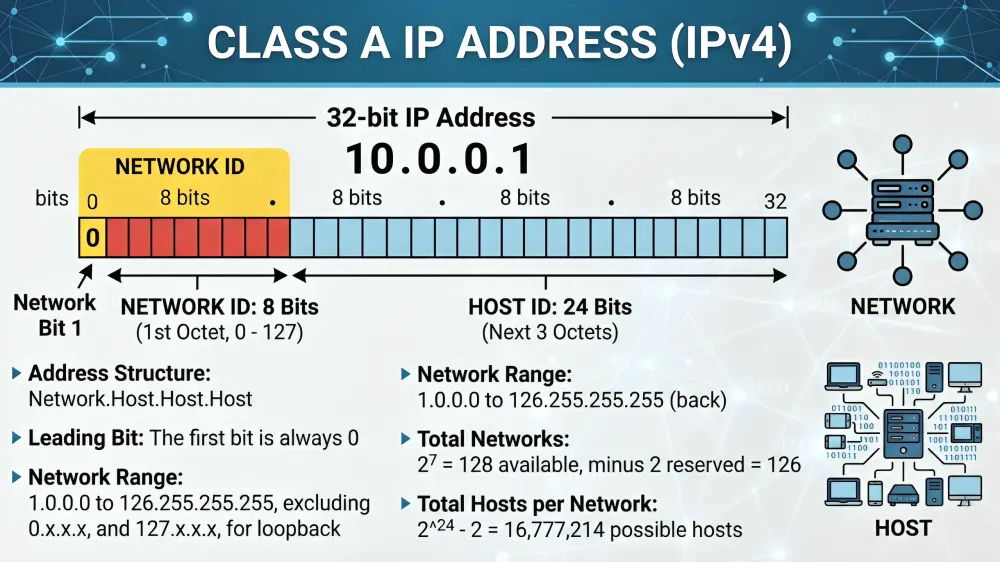
A class of IP address is part of the original IPv4 system that was created to support extremely large networks. It was designed when the internet started growing fast, and organizations needed a way to connect millions of devices under a single network. In simple terms, this type of IP address allows one network to handle a very high number of hosts, which makes it ideal for enterprises and large infrastructures.
Also, the class of an IP address uses the first of the octets to identify the network being used, with the remaining three octets being used to identify individual devices. It is due to this structure that it could be used to support up to 16,777,214 usable hosts which is a colossal number that only a stratum of the universe would support the number of hosts that could be utilized. Thus, it contributed significantly to the development of initial networking systems.
| Component | Description |
| Address Format | IPv4 (32-bit) |
| Network Portion | First Octet |
| Host Portion | Last Three Octets |
| Max Hosts | 16,777,214 |
How Class A IP Address Work in Data Routing?
The working process of a classful IP address depends on how routers interpret the address structure. In the first case, the initial octet, read by a router, determines the network. Next, it looks at the remaining three octets to find the particular host in that network. Due to this two-level identification, the data packets can be effectively transferred between the source and the destination. Also, there are 8 bits in the total length of the address, meaning that the total length of the address consists of 32 bits. The number of combinations possible with this binary structure is large. As a result, millions of unique hosts are supported by a single network under the system.
| Element | Function |
| First Octet | Network Identification |
| Remaining Octets | Host Identification |
| Bit Structure | 32 Bits Total |
Due to this design, making routing decisions takes less time, and large-scale networks can be managed without unnecessary complexity. Thus, as an example, the address could be 10.20.30.40. Here, the number 10 is a representation of the network, and 20.30.40 is a representation of the host. As such, when the data is transmitted, the router will immediately determine the network and send the packet to the appropriate device. This is a step-by-step procedure that guarantees accuracy in communication.
Where Class A IP Address Is Used in Modern Systems
In most internal systems, the role of a Class A IP address remains, although there are newer addressing methods in use. Big companies tend to adopt such address blocks to cater to internal communications among the departments and the location at hand. However, they do not use the full range as a single network but rather partition it into smaller networks using methods of subnetting.
As an example, an organization that has international operations may assign different parts of the address space to different functions like the finance, operations, and research departments. This method enhances a better arrangement and soon has a greater say on the traffic in the networks. Moreover, cloud service providers also use similar internal addressing patterns to handle distributed systems.
In addition, government infrastructures rely on such addressing systems to maintain secure internal communication. Because of their scale, these networks benefit from the large capacity provided by this addressing class.
Common areas of usage include enterprise networks, data centers, and controlled private environments. Therefore, even though the system is considered historical, its practical value still exists in structured deployments.
Types of Class A IP Addresses and Their Functions
A class a ip address is not limited to one fixed purpose. Instead, it includes different categories that help networks operate smoothly in both public and private environments. Each type has a clear role, and understanding these roles makes network design easier and more secure. Below, each type is explained in simple language with practical examples so that you can connect theory with real-world usage.
1. Public Class A IP Addresses and Their Internet Role
Public addresses in a class A IP address range fall between 1.0.0.0 and 126.255.255.255. These addresses are internationally accessible, meaning that the communication devices using them can now communicate directly via the internet. It is due to this that they are generally attributed to large organizations or service providers managing internet-facing systems. In addition, routers around the globe are aware of such addresses, and without limitations, data is able to be transferred between networks.
Consider the following as an example: say a company has its primary website hosted on an address such as 1.0.0.0. The reason is that in this address, users around the world can get access to the server without any internal constraints. You can also come across variations such as 1.0.0.0.1 or 1.0.0.0 in documentation examples but you almost certainly will not come across variations of 1.0.0.0.1 or 1.0.0.0 in the real world. This demonstrates the manner in which public addressing promotes communication in open networks.
2. Private Class A IP Addresses in Internal Networks
The internal communication is reserved for local communication using the range of a ip address 10.0.1.a. They range between 10.0.0.0 and 10.255.255.255, and they do not use the public internet. Due to this limitation, they assist organizations to maintain their internal systems secure whilst still being able to communicate among devices.
As an example, addresses such as 10.0 0.1 or even a variant of that address, such as 10.0 0.1 would be used as an address in configuration references. In administrative setups, users often access routers through paths like 10.0.0.0.1/admin or dashboards labeled 10.0.0.1 login. Although formatting differs in examples, the purpose remains the same, which is to control and manage internal devices efficiently.
3. Loopback Class A IP Addresses for Testing Systems
Loopback addresses in a class A IP address range belong to 127.0.0.0/8. These addresses enable an individual machine to interact with itself rather than transmit information via a network. Due to this reason, developers and engineers use them to test applications, network services, and configurations without having to affect other systems.
For example, while the most common loopback address is 127.0.0.1, similar test references like 0.0. 0.1 may appear in simplified examples. These tests show the functionality of internal testing without traffic leaving the system. This would mean that developers can debug and test their functionality safely, before pushing applications into live environments.
4. Reserved Class A IP Addresses and Their Special Purpose
The unique roles played by the reserved addresses in a class IP address system are supportive of network operations. Such addresses are never used in normal communications but rather serve to assist systems in maintaining connections, making an initial call, and handling errors. A typical example is 0.0.0.0, the address indicating an unspecified address.
An example of this is that, at startup, a system may temporarily make use of similar values like 10.0.0.0.1 or 10.0.0.0.1 in configuration logs before a valid assignment. These illustrations show how reserved addressing helps to maintain processes in the system that are behind the scenes. Consequently, networks are able to boot devices correctly and provide consistent communication.
Risks and Privacy Concerns in Large Address Networks
There are always some risks introduced by large networks, and the class an IP address belongs to is not an exception. The issue of exposing network structure is one of the most significant issues. When the attackers obtain access to address patterns, they are able to map the network and locate the weak points. Preventive actions should, therefore, be taken by organizations to save sensitive information. The other concern is the subsequent movement in the network. Attackers can easily hop from system to system without much guard when such networks have not been properly segmented. A single breach, therefore, can have a wide impact on various systems. The risk is increased in large address spaces due to the number of connected devices.
In addition, it is possible that spoofing attacks may take place when attackers modify the sources of the packets in ways that make them look like a trusted system. This makes it difficult to detect unauthorized access. Nevertheless, filtering and monitoring are some of the techniques that could be used in mitigating this risk. To manage these concerns effectively, organizations use methods like Network Address Translation, subnetting, and strict access control policies. These strategies improve security while maintaining network performance.
Conclusion on Class A IP Address Relevance
The class IP address remains a significant concept in networking, particularly with how large systems are constructed and operated. Even though nowadays the concept of class-based addressing has been substituted with flexibility, the very concept underlying IP communication remains explained.
In addition, even organizations that support large infrastructures tend to apply the same principles to further subdivide networks into manageable units. Hence, when taught this concept, not only do you get to sharpen up on your basics, but you also get to prepare for higher levels of networking.
FAQ
Q1. What Is the IP Range for a Class A IP Address?
The IP range for a Class A network starts from 1.0.0.0 and goes up to 126.255.255.255, which supports very large networks.
Q2. Is the 10.0.0.0/8 Range Always Used for Private Networks?
Yes, the 10.0.0.0/8 block is reserved for private use and cannot be accessed over the public internet.
Q3. Why Was Classful IP Addressing Replaced by CIDR?
CIDR replaced classful addressing because it offers more flexible IP allocation and reduces address wastage.
Q4. How Many Devices Can a Class A IP Address Network Support?
A Class A network can support up to 16,777,214 usable devices, making it ideal for large organizations.
Read Related Blogs: