
Last Updated: 31 August 2026
When exploring how networks work, you will soon discover that IP addressing is a key element in communication. Among the various types, the class b ip address is the best, as it provides a balanced network that is appropriate for expanding networks. On the other hand, it does not crush minor systems’ growth. Due to this balance, year after year various institutions and organizations have relied on this balance.
In this article, you will clearly understand what a Class B IP address means, how its structure works, and why it still matters in networking. Moreover, the discussion will provide an explanation of subnet masks, address types, and applications. Also, you will find out about risks and privacy issues, which are usually disregarded during setup. At the end, you will have clear and practical knowledge that you can put into practice.
What is a Class B IP Address?
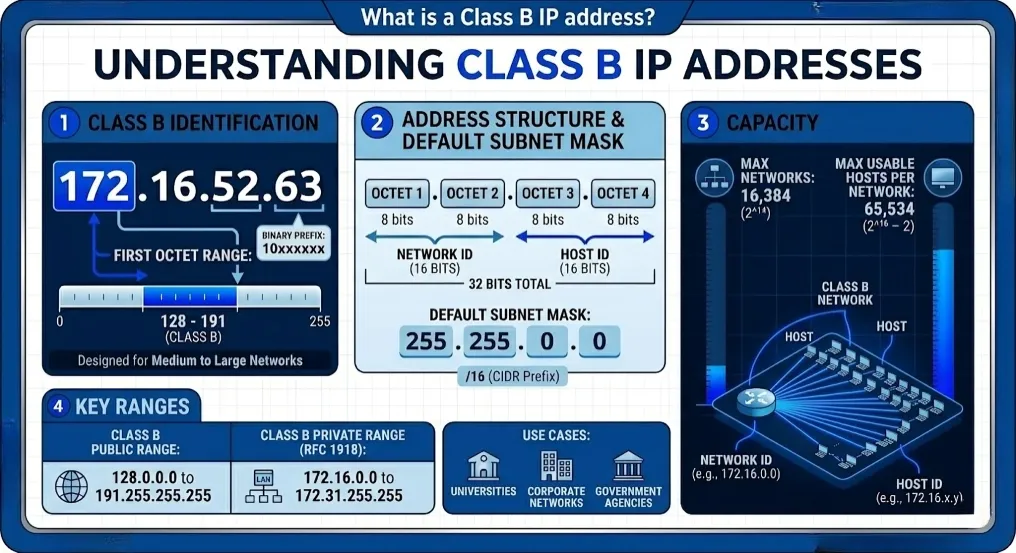
A class B IP address refers to a kind of IPv4 address that helps devices to communicate in medium to large-sized networks. Thus, it acts as a distinctive identifier; all devices in a network are able to transmit and receive data without being confused. Although there are various classes of IP addresses, the Class B IP address is the best since it has a balanced structure. It is not extremely large as Class A nor as small as Class C, so it is convenient for the organization, which requires both flexibility and control.
A network administrator will use a class B IP address in most real-life situations in the event that he/she anticipates an expansion. As an illustration, thousands of devices, such as laptops, servers, and smart systems, can be interconnected in a university campus. Hence, it is advisable to have a well-organized IP system such as this to ensure communication is an easy task and network disputes are prevented. In addition, it facilitates improved organization since devices can be organized intelligently under a single network.
Detailed Structure of a Class B IP Address Explained Clearly
A class B IP address has a logical arrangement that subdivides the address into two distinct parts. It has four octets, with every octet being a number belonging to the range of 0 to 255. Nonetheless, the most important thing is how these octets are divided into network and host parts.
The initial two octets are the network component, and the final two octets are the host or device part. Due to this design, thousands of devices can be supported by a single network, and there is no confusion. Hence, it is more convenient to scale the operations without necessarily redesigning the whole system. Moreover, subnetting is facilitated by this format, so it can be further divided into smaller networks.
| Component | Purpose | Example (172.16.5.10) |
| Network Part | Identifies the main network | 172.16 |
| Host Part | Identifies the specific device | 5.10 |
This structured approach improves organization. It also reduces errors during network management. Consequently, administrators can maintain stability even when the network grows rapidly.
Types of Class B IP Addresses Explained with Practical Examples
A class B IP address can be divided into two main types based on how networks use them in real environments. These categories are either private or public addressing, and all of them have another purpose in communication and security. Although they are under the same category, they work within different scopes, ensuring control and efficiency.
Private Class B IP Address
A private class B IP address is used within internal networks, where communication stays limited to an organization. These networks are not directly related to the internet, and it contributes to enhanced security and prevent additional exposure. The private space falls between 172.16.0.0 and 172.31.255.255, and most organisations use this as their internal space to effectively run their systems. Due to this isolation, companies are able to establish organized settings without fear of conflicts over the universal network.
An example would be a network of a company setting the IP of a server under a department to 172.31.102.40 whilst maintaining all communications within an organization. Meanwhile, a different internal device may also utilize an address such as 192.168.1.6, which enhances internal networking in hybrid configurations once again. Since it protects access to the outside and only personal addressing is required, it will enhance security and minimize threats. With this, organizations are able to scale their systems and to have a higher level of control over sensitive data.
Public Class B IP Address
A public class B IP address allows devices to communicate over the internet without restrictions. The addresses are also unique to the global network, and this means that data is delivered to the appropriate destination. Such as the public addresses, unlike private addresses, are bound to outside systems, which may be websites, servers, and internet services. Thus, online businesses in the provision of online services would require global accessibility, which is facilitated by the use of a public address.
As an example, the application on a web server can be hosted on a server with the address of 128.199.182.182 and be accessed by different users all over the world. Likely, another system would have a different address, like 142.250.187.174, that would allow easy interregional communication. The fact that these addresses are still visible throughout the world means that administrators need to ensure that they have been secured. Nevertheless, they are flexible and scalable and thus are imperative to contemporary internet-based operations.
Overview of Class B IP Address Types with Examples
The table below provides a clear comparison of both types along with practical IP examples. Each example reflects how networks assign addresses in real scenarios while maintaining structure and communication flow.
| Type | Description | Example IP Address |
| Private | Used for internal communication | 172.31.102.40 |
| Private | Internal hybrid network usage | 192.168.1.6 |
| Public | Internet-facing server communication | 128.199.182.182 |
| Public | Global service access | 142.250.187.174 |
| Public | External enterprise connection | 183.63.127.22 |
| Public | ISP-level communication | 122.176.18.49 |
| Public | Regional network routing | 175.107.59.138 |
| Public | Data center infrastructure | 164.151.129.231 |
| Public | Cloud-based service connection | 147.50.148.236 |
| Public | Secure endpoint communication | 185.63.253.20 |
| Public | Large-scale network routing | 170.254.95.226 |
| Public | Application hosting server | 134.209.250.149 |
This overview highlights how both types of a class B IP address operate in different scenarios. Private addresses focus on security and internal communication, while public addresses ensure global connectivity. Because both types serve distinct roles, organizations often use them together to build efficient and secure networks.
Subnet Mask for Class B and Network Capacity Details
A subnet mask is important in determining the way in which a Class B IP address works. It identifies which portion of the address is a part of the network and which part of the address is a part of the host. Without this mask, the devices would not know how to effectively communicate.
The default subnet mask of this class is 255.255.0.0. Such an arrangement implies that the initial two octets are fixed and the rest of the octets can be allocated to devices. Due to this configuration, this network can support many hosts.
| Feature | Value |
| Default Subnet Mask | 255.255.0.0 |
| Total Networks | 16,384 |
| Hosts per Network | 65,534 |
The requirement can be attributed to its appropriateness in environments mandating growth. Furthermore, subnetting gives the administrators an opportunity to subdivide the network into smaller categories. This leads to better performance, and managing it is also made easier.
Use Cases of Class B IP Addresses in Real Environments
The class B IP address serves various industries where network size and structure matter. It allows for supporting thousands of devices without having to redesign it always. Thus, it turns out to be a feasible option to expandable companies.
This system is usually used by educational institutions to control the network of students, labs, and administration systems. Corporate offices are also using it to connect internal tools, more so employee devices, as well as servers. It is also favored by government bodies due to its ability to promote structured and secure communication.
Moreover, this addressing system works in the context of IoT. Cameras and sensors are smart devices that need efficient communication. Since such systems are scalable by this structure, it aids in managing them. Due to this, organizations are able to grow without encountering significant constraints.
Risks and Privacy Concerns in Class B IP Usage
Although the class B IP address offers many advantages, it also presents certain risks. Unless administrators plan, big networks can be very hard to monitor. Hence, they are required to be properly managed to prevent problems. The issue of unauthorized access is one of the biggest issues. Attackers may take advantage of vulnerabilities if internal systems are not maintained with adequate security. Secondly, subnetting might cause confusion and data leaks. This means that network boundaries should be planned out by the administrators.
In addition, large host ranges need effective tools to be monitored. In their absence, it is difficult to monitor activity. Nevertheless, firewalls, encryption, and frequent audits can help organizations minimize risks. As a result, they will be able to preserve security and performance.
Conclusion
A class B IP address continues to play an important role in networking because it provides a strong balance between scalability and control. It manages thousands of devices, has a simple structure, and fits in expanding environments without complexity. When you know about its structure, types, and actual use, you could be able to design networks effectively. Hence, the selection of an appropriate addressing technique can result in enhanced performance and sustainability in the long-term.
Read Related Blogs: