
The mechanism of IP addresses may seem difficult to understand, but once you start dividing them into logical groups, everything will become much easier to understand. IPv4 classes are important in networking since they determine how addresses were initially grouped and allocated. So, the study of this concept forms a solid foundation to more advanced studies such as subnetting and routing. In this elaborate discussion, you will learn the structure, differences in ranges, and the functions of private and special IPs. Additionally, you will also learn how contemporary systems transitioned to CIDR and IPv6 and retained these essentials.
Overview of IPv4 Classes in Networking
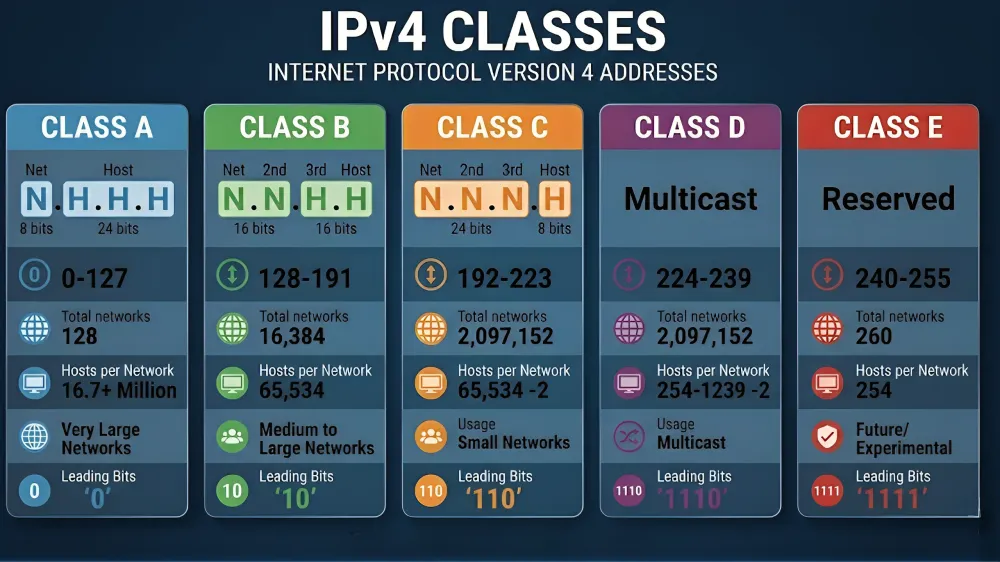
When the Internet started growing, engineers needed a structured way to assign IP addresses efficiently. Consequently, they also came up with IPv4 classes that subdivide addresses into five groups (A, B, C, D, and E). Both classes specify the size of a network and the number of devices that they can support.
An IPv4 address consists of four octets with dots between them, e.g., 192.168.1.1. Class is decided by the first octet, and the other parts comprise the network and host portions. As a result, this architecture aided in address space management during early Internet architecture.
These types of classes vary in capacity. Class A of utilization serves huge networks, whereas Class C serves small policies such as households and workplaces. In the meantime, Classes D and E are not intended to give addresses to any device, but instead have specialized applications.
IP Class & Mask Finder
An IP Class & Mask Finder helps identify the class of any IPv4 address quickly. For instance, when you enter an address like 172.16.10.5, the tool instantly shows its class and subnet mask. This process saves time and reduces manual calculation errors.
These kinds of tools also show whether an IP is a private or a public one. Thus, they are popular in training facilities and labs. They also give clarity in dealing with real-world settings.
Class A IPv4 Address Structure with Correlated Examples
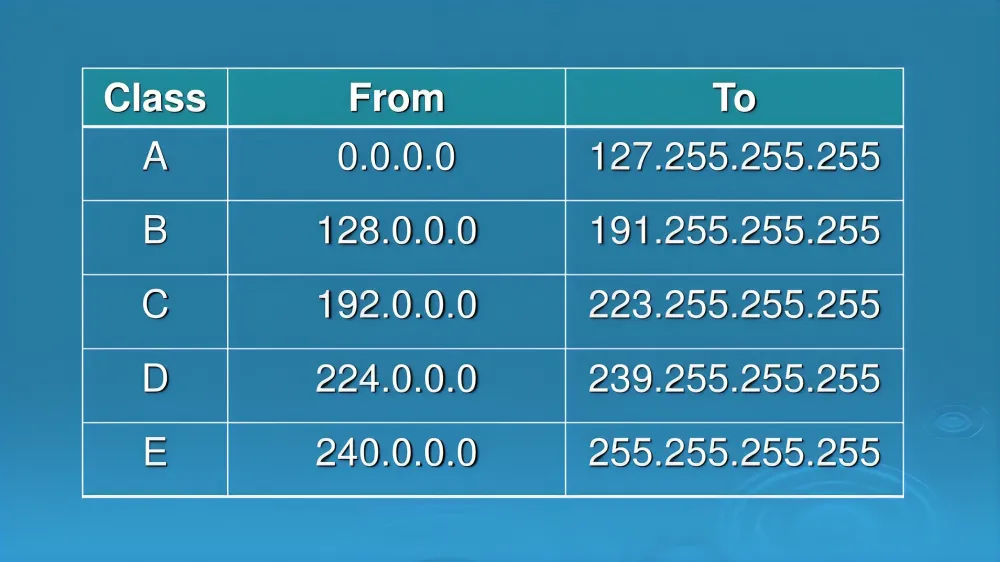
Class A networks can handle very large infrastructures since millions of hosts can be supported in a single network. Network is defined by the first octet, and devices are defined by the other three octets. Hence, big businesses and multinational service providers tend to use these networks. The valid range for Class A starts from 1.0.0.0 to 126.255.255.255. In addition, the private range 10.0.0.0 to 10.255.255.255 is widely used in internal networks. But not all IP addresses starting with a similar number are valid, and therefore, formatting is significant.
For example, 10.230.5.15 and 10.24.1.53 are valid private Class A addresses used inside organizations. Similarly, 13.127.144.213 and 103.203.136.98 represent public IPs used on the internet. On the other hand, entries like 10.0.0.0.1 or 10.24.0.1.53 are invalid because IPv4 format allows only four octets.
| Category | IP Example | Status |
| Valid Public | 1.0.0.0 | Valid |
| Invalid Format | 1.0.0.0.1 | Invalid |
| Private | 10.0.0.1 | Valid |
| Invalid Format | 10.0.0.0.1 | Invalid |
| Invalid Format | 10.0 0.1 | Invalid |
| Invalid Format | 0.0. 0.1 | Invalid |
| Private | 10.230.5.15 | Valid |
| Private | 10.24.1.53 | Valid |
| Private | 10.24.39.113 | Valid |
| Public | 122.176.18.49 | Valid |
| Public | 183.63.127.22 | Valid |
| Private | 10.24.1.71 | Valid |
| Invalid Format | 10.24.0.1.53 | Invalid |
| Public | 122.176.83.125 | Valid |
| Public | 13.232.238.236 | Valid |
| Public | 111.159.90.132 | Valid |
| Private | 10.24.0.1.71 | Invalid |
| Public | 111.90.150.188 | Valid |
| Public | 124.105.5.80 | Valid |
| Public | 13.127.144.213 | Valid |
| Public | 103.203.136.98 | Valid |
| Invalid Format | 10.24.53 | Invalid |
Class B IPv4 Address Structure with Correlated Examples
Class B networks are made to support medium to large companies. They use the first two octets for the network and the remaining two for hosts. Therefore, they provide a balance between scalability and manageability. The valid range for Class B extends from 128.0.0.0 to 191.255.255.255. In addition, the private range 172.16.0.0 to 172.31.255.255 allows internal network usage. But not all IPs listed could be part of another classification, or could just be examples to compare.
An example of such a valid private Class B address is 172.31.102.40, which is used in organizations. Similarly, 128.199.182.182 and 134.209.250.149 are valid public Class B IPs. Nonetheless, in fact, 192.168.1.6 falls under Class C where the emphasis is on the fact that classification is important.
| Category | IP Example | Status |
| Public | 183.63.127.22 | Valid |
| Public | 122.176.18.49 | Valid |
| Public | 175.107.59.138 | Valid |
| Public | 164.151.129.231 | Valid |
| Public | 147.50.148.236 | Valid |
| Public | 128.199.182.182 | Valid |
| Class C Example | 192.168.1.6 | Different Class |
| Public | 185.63.253.20 | Valid |
| Private | 172.31.102.40 | Valid |
| Public | 170.254.95.226 | Valid |
| Public | 134.209.250.149 | Valid |
| Public | 142.250.187.174 | Valid |
This comparison clearly shows that some IPs may appear similar but belong to different classes.
Class C IPv4 Address Structure with Correlated Examples
All IPv4 networks all fall under the concept of classes C of which classes A and C are the most popular, given that they are favored in smaller environments. These include homes, offices, and small business networks. They use three octets for the network and one for hosts. The valid range for Class C starts from 192.0.0.0 and ends at 223.255.255.255. The private range 192.168.0.0 to 192.168.255.255 is widely used in local networking setups. However, formatting errors are common in manually written IP lists.
For example, 192.168.1.100 and 192.168.0.254 are valid Class C private addresses used in home networks. Similarly, 196.192.73.13 is a valid public Class C IP. However, entries like 192.168.1001 or 192.168 l 1.11 are invalid due to formatting mistakes.
| Category | IP Example | Status |
| Private | 192.168.1.2 | Valid |
| Private | 192.168.1.100 | Valid |
| Private | 192.168.11.1 | Valid |
| Invalid Format | 192.168.1001 | Invalid |
| Incomplete | 169.254 | Invalid |
| Private | 192.168.4.1 | Valid |
| Private | 192.168.1.3 | Valid |
| Private | 192.168.7.1 | Valid |
| Invalid Format | 192.168 l 1.11 | Invalid |
| Private | 192.168.0.254 | Valid |
| Private | 192.168.1.250 | Valid |
| Invalid Format | 192.168 l 254.254 | Invalid |
| Private | 192.168.1.6 | Valid |
| Public | 196.192.73.13 | Valid |
This table highlights how correct formatting plays a critical role in identifying valid Class C addresses.
Final Correlation of IPv4 Classes A, B, and C
When you analyze all three classes together, patterns become clearer. Class A operates very large networks, Class B offers medium-sized networks, and Class C offers small networks. Nonetheless, there are always formatting mistakes that can be confusing, particularly in writing IP addresses in an erroneous manner.
Through the correlation of these examples, you can determine which IP is in Class A, B or C based on the first octet and structure. Additionally, invalid formats can also be easily detected, and critical troubleshooting and network setup. Hence, learning IPv4 classes, using actual examples, is not only beneficial to theoretical communication but also provides practical expertise regarding any real-world networking endeavors.
Class D IP Address Range and Multicast Communication
Class D addresses do not have unique IPs assigned to devices. They, instead, favour multicast communication, where a single sender sends data to multiple receivers at the same time.
This range spans from 224.0.0.0 to 239.255.255.255. It is an essential part of such applications as live streaming, video predicting, or real-time provision of data. It therefore enhances efficiency by minimizing redundant transmissions.
As an illustration, multicast will be effective when a company broadcasts a live event to thousands of employees to enable the efficient flow of data in the network.
Class E IP Address Class and Its Reserved Purpose
Class E addresses are reserved for experimental use. They range from 240.0.0.0 to 255.255.255.255 and are not assigned to regular devices. Therefore, you will not encounter them in typical networking setups.
Although they are part of the classification system, their role remains limited to research and testing. As a result, most systems treat them as invalid or unused addresses.
Private IP Addresses in Internal Networking Systems
Local networks make use of private IP addresses. They are not accessible directly via the internet, which allows for maintaining greater security and saving the public IP resources.
Organizations use these addresses on devices like computers, printers, and servers. They apply Network Address Translation (NAT) to these devices, then connect them to the internet.
Private IP Range:
| Class | Range |
| A | 10.0.0.0 – 10.255.255.255 |
| B | 172.16.0.0 – 172.31.255.255 |
| C | 192.168.0.0 – 192.168.255.255 |
This approach ensures efficient use of IP space while maintaining network security.
Special IP Addresses (IPv4) and Their Unique Roles
Some IP addresses are used by particular functions in a network. Such addresses are not ordinary host addresses, but, at the same time, they serve such important purposes as communication and testing. An example is that the loopback address, which is 127.0.0.1, enables a system to talk to itself. Meanwhile, 0.0.0.0 represents an unknown or default route. Additionally, 255.255.255.255 is used for broadcasting messages within a local network. Similarly, link-local addresses like 169.254.x.x are assigned when DHCP fails.
Interactive IPv4 Address Analyzer for Learning and Testing
An interactive IPv4 analyzer is a tool that enables users to get to know how addresses behave. Users can determine the class and subnet mask of an IP as well as the type of use by entering the IP address. It is used to simplify complex calculations and also gives immediate feedback. Thus, students and professionals use it when practicing and in troubleshooting. Furthermore, it assists in visualizing the functioning of IP ranges and classes in the real world.
Summary of IPv4 Classes with Key Differences
The table below highlights the key differences among address classes. It provides a quick comparison for better understanding.
| Class | Range | Subnet Mask | Hosts |
| A | 1–126 | 255.0.0.0 | 16M |
| B | 128–191 | 255.255.0.0 | 65K |
| C | 192–223 | 255.255.255.0 | 254 |
This classification simplifies the learning process. However, modern systems use more flexible approaches.
Relevance of IP Classes Today in Modern Networking
Although IPv4 classes are no longer used for real-world allocation, they still hold educational importance. They assist learners in having an idea of how IP addressing has developed. Also, certification examinations tend to have questions concerning these classes. Thus, learning them enhances your knowledge of networking concepts.
What is CIDR?
CIDR substituted the classical means of addressing, which was based on classes, with a flexible system. It enables networks to distribute IP addresses as required and not as a predetermined limit. In the case of a/24 network, it offers 256 addresses, whereas in the case of a/27 network, it offers just 32. This is flexible and saves wastage and enhances efficiency.
CIDR / Hosts Explorer
A CIDR explorer tool is useful in visualizing the change in size of subnets corresponding to a prefix length. It displays total addresses, hostnames that can be used, as well as the subnet mask.
| Prefix | Total IPs | Usable Hosts |
| /24 | 256 | 254 |
| /27 | 32 | 30 |
Such tools assist in planning and designing networks effectively.
The Rise of IPv6
IPv6 was developed due to the depletion of IPv4 addresses. It offers a huge address space and removes the use of classes. Moreover, IPv6 enhances routing and makes network setup easier. Thus, it is slowly taking IPv4 out of contemporary systems.
Conclusion About IPv4 Classes
Learning IPv4 classes builds a strong foundation for understanding networking concepts. Although current systems use CIDR and IPv6, these classes provide an easy way to understand the underlying mechanism of IP addressing and an easier way to understand more advanced issues.