
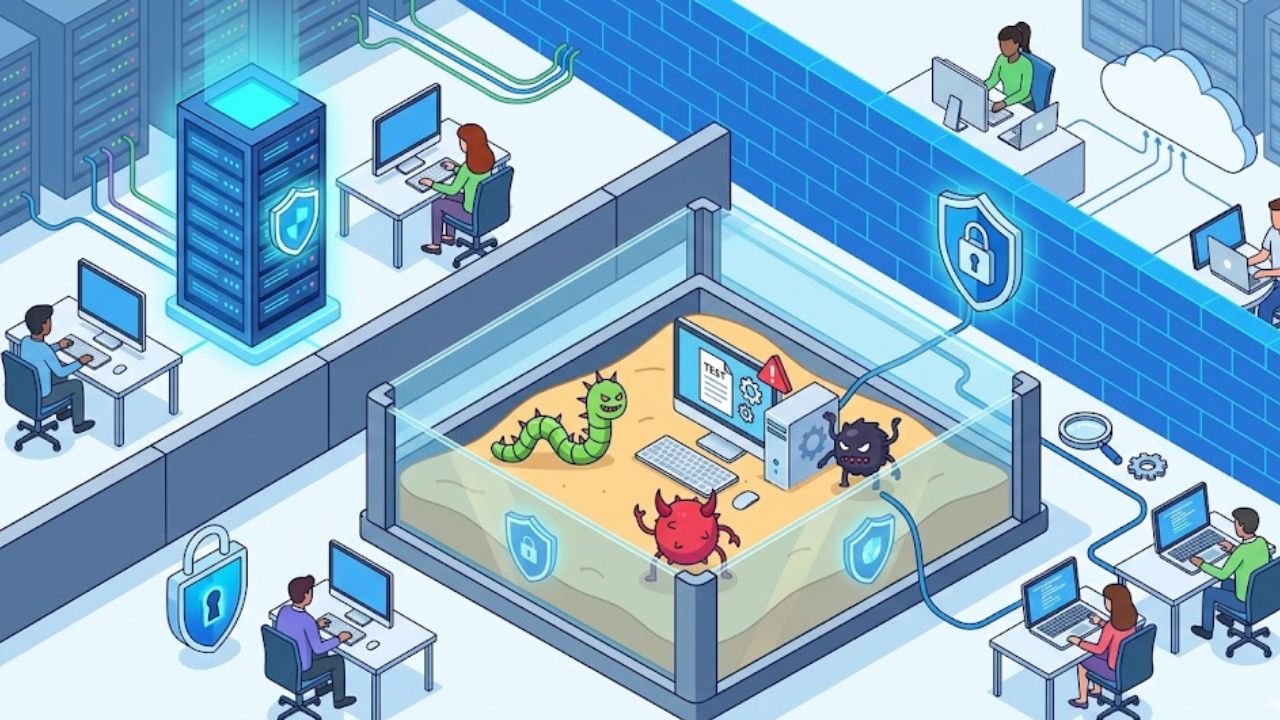
Digital threats no longer arrive with warning signs, and modern systems must rely on smarter protection methods. This is precisely the reason why it is currently vital to know what is a sandbox in cybersecurity as applied to businesses, developers, and even common consumers using files and applications. Also, attackers have acquired sophisticated methods that are beyond conventional filters, and antivirus software can no longer be the sole tool of defense. Consequently, an organizational requirement is the method that monitors the behavior rather than depending on the file signatures. You will gain an understanding of the benefits of sandboxing, its functionality, functionality and environments, and the differences between cloud and appliance solutions in the real world in this article. Moreover, the discussion elaborates how sandboxing facilitates testing, enhances collaboration, and strengthens long-term security.
What Is Sandboxing?
Sandboxing is a security precaution that builds an isolated place where suspicious files or programmes can be executed safely without impacting the real system. Moreover, such an environment is a virtual wall of an uncontrolled environment where security teams can monitor behavior without threats. As an example, a file that tries to connect to untrusted servers and/or access sensitive information is flagged and logs every action in the sandbox. This leads to the early detection of harmful activity that can be shut down without affecting the main system.
Furthermore, sandboxing can be used to counter zero-day attacks, which are not known threats that cannot be detected by traditional technologies. Thus, instead of being based on established patterns, sandboxing is concentrated on real-time measures of behavior, which contributes to its high reliability in contemporary cybersecurity systems.
What is a Sandbox in cybersecurity systems?
To gain deeper clarity, it is important to explore sandbox environments because they form the foundation of this security method. The sandbox environment is a virtual installation that approximates real operating systems and applications in such a way that files can be safely and controlled by them.
Furthermore, these environments reproduce the actual user conditions, to be precise, such that the tested file acts in a natural manner and then does not conceal its real purpose. Consequently, developers and security teams do not have to compromise live systems to find out vulnerabilities, test features, or analyse risks.
Common uses of sandbox environments
Sandbox environments support several functions that improve both security and development processes:
- Safe execution of unknown applications
- Testing new features without affecting live systems
- Performing debugging and quality checks
- Allowing client demonstrations in a controlled setup
Moreover, sandbox environments can be used in other surfaces in addition to security, such as product testing, quality assurance, and software integration. This is why organizations usually make use of such environments in order to streamline development processes and ensure enhanced user experiences.
Benefits of Sandboxing for security and development teams
Understanding the benefits helps explain why organizations invest heavily in sandboxing technologies. Sandboxing enhances the security aspects as it identifies threats in isolation; its capability to achieve operational efficiency with testing environments that are flexible.
| Benefit | Explanation | Example |
| Secure testing | Runs risky files safely | Testing suspicious attachments |
| Cost efficiency | Reduces hardware needs | Using cloud-based solutions |
| Collaboration | Teams share environments | Joint testing by QA and dev teams |
| Threat analysis | Studies malware behavior | Identifying attack patterns |
| Faster deployment | Detects issues early | Fixing bugs before release |
Furthermore, sandboxing assists the organization in learning from the threats, as they are able to study the functioning of the attack. Thus, it reinforces short-term and long-term defense measures.
Why is sandboxing important in modern cybersecurity systems?
Sandboxing remains significant since cyber threats have been increasingly intricate and difficult to detect. Most of the attacks made nowadays are hidden and gradually affect the performance of the system rather than inflicting any immediate damage.
Besides, sandboxing offers the possibility of detecting such covert threats at an early stage by studying the behavior regardless of the known signatures. This way, organizations are able to prevent attacks before they permeate through the network.
Moreover, sandboxing provides the capability of teams to get into the details of threats, that enable the teams to learn the patterns and enhance security measures. As such, it serves as a defensive and educational tool for cybersecurity systems.
Cloud-based Sandboxing vs Appliance-based Sandboxing explained clearly
The decision to implement cloud-based or appliance-based sandboxing is mostly subjective and frequently rests on the operational requirements of all organizations. Both methods are advantageous in their own way, and knowing both can assist in making more of the right choices. It is hosted on remote servers, and this aspect implies that the files are tested externally to the local organization’s network. Conversely, appliance-based sandboxing is implemented on physical hardware on its infrastructure.
In addition, cloud-based systems are more flexible and scalable, whereas appliance-based systems are better able to control data and systems. This leads to companies making decisions according to their security priorities and capabilities.
| Feature | Cloud-based sandboxing | Appliance-based sandboxing |
| Accessibility | Available remotely | Limited to local network |
| Cost | Lower setup cost | Higher infrastructure cost |
| Scalability | Easily expandable | Limited by hardware |
| Security isolation | Fully separate environment | Requires careful setup |
| Remote support | Ideal for remote teams | Difficult for remote users |
Moreover, cloud-based sandboxing minimizes the danger of contaminating the system since files will not be shared with other local systems. Hence, it has gained popularity over the past few years.
What is a cloud sandbox in cybersecurity systems?
A cloud sandbox is an environment that is hosted on remote servers and where files and applications can be securely tested. This way, the impact of any kind of malicious act is kept separate to regional systems.
Additionally, cloud sandboxing embraces flexibility since users are able to access it anywhere without having physical infrastructure. This means that organizations are able to carry out testing and analysis without geographic constraints.
What is a cloud sandbox and its practical advantages?
In addition, cloud sandboxing offers an organization the opportunity of scaling resources without a challenge, and this enables it to be able to conduct numerous tests at a time. As such, teams will be able to achieve efficiency in addition to high security standards. Nevertheless, it is also imperative that appropriate surveillance is conducted since other sophisticated threats strive to be undetected. Notwithstanding, cloud sandboxing is still an effective and trusted solution to contemporary cybersecurity problems.
Key differences between CyberCapture vs Sandboxing
Sandboxing is concentrated on tests and analysis; however, there are other technologies like CyberCapture that concentrate on detection and classification. This difference can be understood to explain the complementary effects of these tools.
CyberCapture automatically scans potentially suspicious files to be further scanned and sandboxing lets you test a file directly in a controlled setting. Therefore, sandboxing provides more control and detailed insights into file behavior.
Key differences
- Sandboxing focuses on behavior analysis
- CyberCapture focuses on detection
- Sandboxing allows controlled execution
- CyberCapture uses automated classification
Moreover, both approaches work together to improve overall security because detection and analysis complement each other effectively.
Advanced sandbox security solutions and system integration
In the context of discussing what is a sandbox in cybersecurity, many organizations tend to think about the highly sophisticated security tools offering dedicated sandboxing. These systems involve the use of modern techniques that are effective to analyze the threats and protecting the networks.
In addition, sophisticated sandbox tools do the dynamic and static analysis, i.e., the structure of a file is studied, the behavior of the file is observed. Consequently, they are able to detect concealed threats that otherwise could not be observed when doing simple checks.
| Feature | Description |
| Multi-system simulation | Tests across different operating systems |
| Behavior monitoring | Tracks real-time activity |
| Integration | Connects with firewalls and tools |
| Automated reporting | Provides detailed insights |
| Threat isolation | Contains harmful activity |
Furthermore, integration with other security tools improves overall defense, because sandboxing becomes part of a broader security framework.
Real-world application of sandboxing in cybersecurity
In the real-world environment, sandboxing assists organizations in dealing with suspicious files in a secure manner. Respectively, an employee who has been sent an unknown task in the form of an email would run the risk of exposing the system to malware once he/she opens the email attachment.
Instead, the file is run in a sandbox, and its behavior is monitored closely. When it tries to execute actions that are harmful, the system will instantly block it. Consequently, the organization would neither have to suffer a possible harm, nor would it be unaware of the threat.
Additionally, sandboxing will enable development teams to test new applications, which will not impact production systems. Thus, it enhances security and innovation.
Conclusion
Understanding what is a sandbox in cybersecurity helps you see how modern systems protect themselves from advanced threats. It offers a safe platform to do testing, analysis, and learn without compromising the primary infrastructure. Furthermore, sandboxing increases efficiency and lowers the cost, and also improves cross-team collaboration. It has thus emerged as a vital part of cybersecurity plans in both big and small organizations. Thus, it is not only technically but also a strategically sound idea to adopt sandboxing and guarantee the stability of the system and its protection over the long term.
FAQs
Q1. What does sandboxing mean in cybersecurity?
It means running files in a safe environment to prevent damage to the main system.
Q2. Why do organizations use sandbox environments
They use them to test applications and detect threats without risk.
Q3. How does sandboxing improve security?
It detects unknown threats by analyzing behavior instead of relying on signatures.
Q4. What is the role of cloud sandboxing?
It allows secure testing in remote environments without affecting local systems.
Q5. Is sandboxing suitable for small businesses?
Yes, because it provides affordable and effective protection against threats.
Q6. Does sandboxing replace antivirus tools?
No, it works alongside antivirus systems to provide better security.
Read Related Blogs: