
Online privacy is no longer optional; it has become a daily concern for users who browse, shop, or work on the internet. The comparison of proxy vs vpn occurs due to some people claiming that both technologies can provide anonymity, but in a rather different manner. With the increased use of the internet, the problem of confusion is also increasing, particularly among new users and small business users who are after straightforward yet effective protection.
This paper will explain to you clearly what is a proxy vs vpn, the functionality of each tool, and their application in actual life. In addition, their types, differences, and current applications are presented in a systematic manner. Thus, you are able to make an informed choice without making a guess or referring to old-fashioned information.
What is a Proxy vs VPN? The key differences
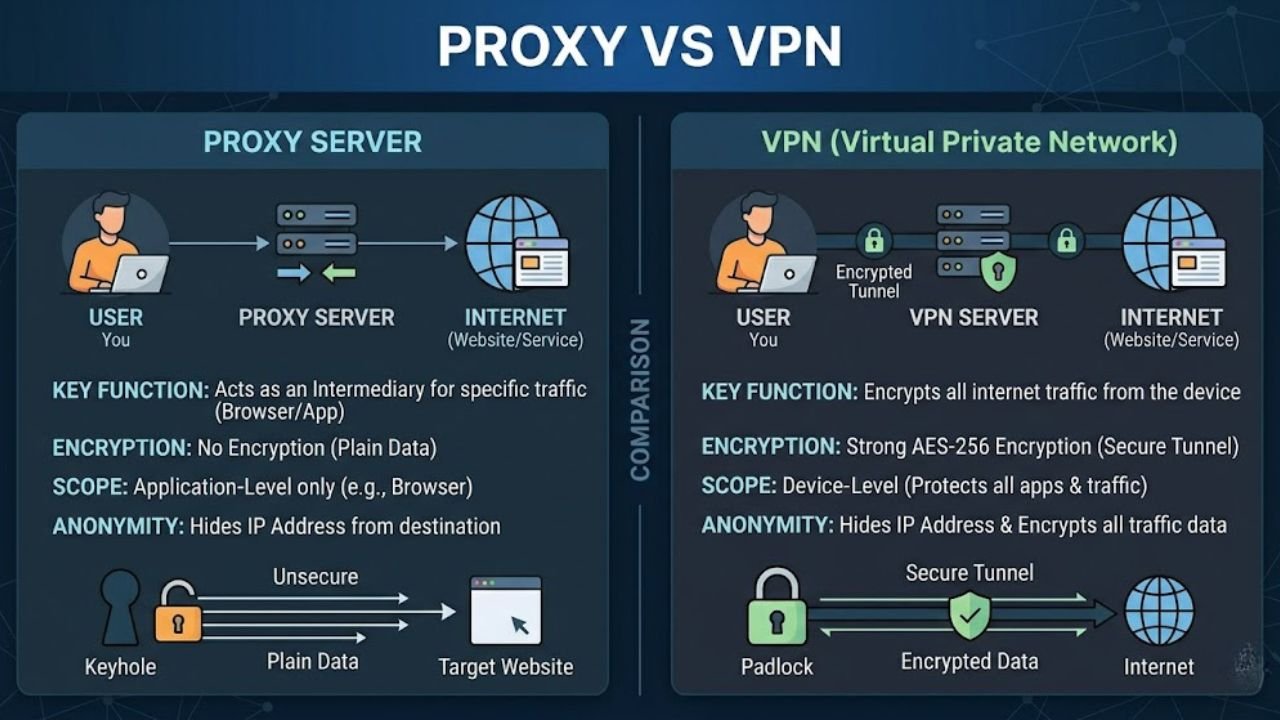
In comparing proxy vs vpn, users tend to think in terms of privacy, security, and performance. However, the two tools conceal your IP address; they work differently. A proxy simply acts as an intermediary between your device and the internet. Instead, VPN creates a secure tunnel that encrypts all your traffic.
Owing to this structural distinction, VPNs provide better cyber protection against cyber threats. Conversely, proxies are speedier as they do not require encryption. It is thus up to you to determine. You should be inclined towards a VPN if you desire security. A proxy will do the trick, should speed be the goal.
| Factor | Proxy Server | VPN |
| Data security | Limited | Strong encryption |
| Speed | Faster | Slightly slower |
| Privacy | Basic anonymity | Full privacy |
| Usage | Specific apps | Entire device |
What is a Proxy Server and How Does It Work?
A proxy server is a point that intermediates between your machine and the web pages that you browse. It gets your original IP address substituted with theirs, meaning that websites will not know who you are directly. Nonetheless, your data is not encrypted so under some conditions, your activity still can be tracked.
When individuals query what is a proxy vs vpn, they tend to confuse proxies with complete security tools. In practice, proxies are primarily used to aid access control and anonymity. They are widely applied in the office, school, and environment in which one is interested in controlling internet traffic.
Forward proxy
A forward proxy is another name of a proxy. It makes requests on clients and transfers it to external servers. This arrangement enables the organizations to regulate and oversee the usage of the internet. Indicatively, forward proxies are commonly applied by companies to block specific websites. Consequently, employees do comply with the company policies without having their devices limited.
Transparent proxy
A transparent proxy works without user awareness. It does not alter any requests but still directs traffic. Hence, the users are able to browse normally without being aware that it seems like a proxy is used. But transparent proxies can be found in a public network, like a school or cafe network. They assist administrators in tracking down the traffic and keep user experience at an appropriate pace.
Anonymous proxy
An anonymous proxy hides your IP address but still identifies itself as a proxy. The privacy is moderate with this method. It is effective when the user would like to be undetected by websites but at the same time, does not need sophisticated security. However, anonymous proxies might be blocked by certain websites. As such, they will be effective depending on the platform you reach.
High anonymity proxy
The high anonymity proxy provides even better privacy. It even conceals your IP address as well as the information that you are using a proxy. Therefore, websites are not able to identify your real identity or use of the proxies. This form is highly anonymous but there are risks of using free versions. Therefore, users must select trusted providers to prevent exposure of their data.
Distorting proxy
A distorting proxy sends a deceptive IP address to the websites. It also claims to be a proxy server. The combination enables users to look like they are browsing somewhere else. They are, however, blocked by some sites. Thus, in some cases, problems can occur with access.
Data center proxy
A data center proxy originates at a data center rather than an ISP. It offers high speed and low cost. Thus, it is commonly used by marketers who need data scraping or testing. On the negative, such proxies are not very anonymous. They may be identified and blocked with weapons on a webpage.
Residential proxy
A residential proxy is an IP address of a physical device. Consequently, it seems more acceptable to websites. Thus, it can be used in checking ads and in geo-targeting testing. Residential proxies tend to be pricier, though. They need to be cost-effective and reliable to the users.
Public proxy
A public proxy is free and accessible to anyone. It enables users to window shop without incurring any fee. Nonetheless, it can be slowed down by extensive traffic. In addition, there are security risks of using public proxies. They can be used by hackers to obtain sensitive information.
Shared proxy
A common proxy can be used by more than one user. It is economical as users are using the same IP address. As such, it is affordable to those with smaller budgets. But common use may be problematic. When one user acts suspiciously, the whole IP can even be blocked.
SSL proxy
An SSL proxy encrypts data between the client and server. It offers additional protection when compared to regular proxies. Many organizations, therefore, tend to use it to encrypt delicate traffic. Nevertheless, the performance can be reduced by using the SSL proxies. Users are to take this trade-off into account when deciding on them.
What is a VPN, and why does it offer better protection?
VPN will provide a secure network between the internet and your device. It codes any information passing via the network. Thus, although one may intercept the data, they will not be able to read its contents. When people seek to find out the meaning of a proxy and vpn, they soon realize that VPNs are more secure. However, proxy vs vpn secure all the applications of your device. Because of this, they are prevalent amongst businesses, freelancers, and travelers alike.
Corporate VPN
Corporate VPN offers corporations the protection of employee networks. They enable employees to access company resources from a secure location regardless of their location. Thus, corporations keep their data safe even when working remotely. In addition, business VPNs are centrally controlled. IT teams are able to track and implement policies effectively.
Individual VPN
Individual VPNs cater to personal users. They safeguard web usage and encrypt Wi-Fi networks. Therefore, users are able to navigate with peace of mind since they are not fearful of hackers. Moreover, personal VPNs assist users in visiting restricted material. This aspect has popularized them with streaming and gaming communities.
Proxy vs VPN: Security, Privacy, and Speed Breakdown
Security
The most significant aspect in the proxy vs vpn comparison is security. The proxy is not able to encrypt your data, hence it can get intercepted by the attacker. Conversely, VPN encrypts all the traffic, leaving it incomprehensible. Hence, VPNs are more secure in performing confidential activities like banking or work communication.
Privacy
Privacy also differs significantly. A proxy conceals your IP address, but not your activity. Conversely, VPN conceals both your browsing information and IP. This means that VPN users are fully anonymous. This surrogate comes into play in hazardous conditions.
Speed
Speed tends to have an effect on user choice. Proxies tend to have better performance since they do not undergo encryption. VPNs can decrease speed slightly, though, because of the encryption processes. However, the effects of this are reduced by modern VPN services. Thus, it is oftentimes not a significant distinction between everyday users.
Fortinet products & services
Modern cybersecurity solutions go beyond traditional tools like proxy and VPN. Organisations are using integrated systems that integrate on several levels of protection. These systems have uniform security on compounding devices and networks. Fortinet solutions are oriented towards integrated security frameworks.
They unite users, devices, and applications into a unified system. Thus, organizations have access to their visibility and control over networks. Also, zero-trust architecture is important. It authenticates all users and devices. Consequently, it makes it so hard to have unauthorized access.
VPN Resources
Understanding VPN technology helps users make informed decisions. The users are able to study the concepts of remote access VPN, site-to-site VPN, and encryption protocols. These discussions describe the way in which VPNs ensure secure network-wide communication.
Also, awareness is enhanced by learning about trends in network security. Dangers can be detected by the user, and more effective protection mechanisms are selected. So, lifelong learning is required in the new online world.
Conclusion
Choosing between proxy vs vpn depends on your needs and priorities. The proxy is fast, provided with easy anonymity, whereas a VPN is secure and completely private. VPN solutions should therefore be the ones that are favored by users working with sensitive information. The risks of the internet are increasingly becoming a reality, and acquiring knowledge of these tools will enable you to remain safe and secure on the internet.
Read More Related Blogs: