
Most people hear the terms VPN and proxy and assume they do the same thing. Both applications conceal your IP address and aid you in overcoming the blocked content, hence the misunderstanding. However, they occur and operate very differently and provide very different protection levels. Knowing the real difference between what is a vpn vs proxy helps you pick the right tool at the appropriate time, depending on whether privacy, speed, or security is a concern.
A proxy server is an intermediary between the internet and your device. By comparison, a VPN will establish an entirely encrypted tunnel that wraps around your whole connection. The very point of difference between them is encryption, and this difference is more significant than many may be aware. To be more specific, before making another selection over another tool, it can be done to see what each tool actually does and its shortcomings.
What Is a VPN vs Proxy?
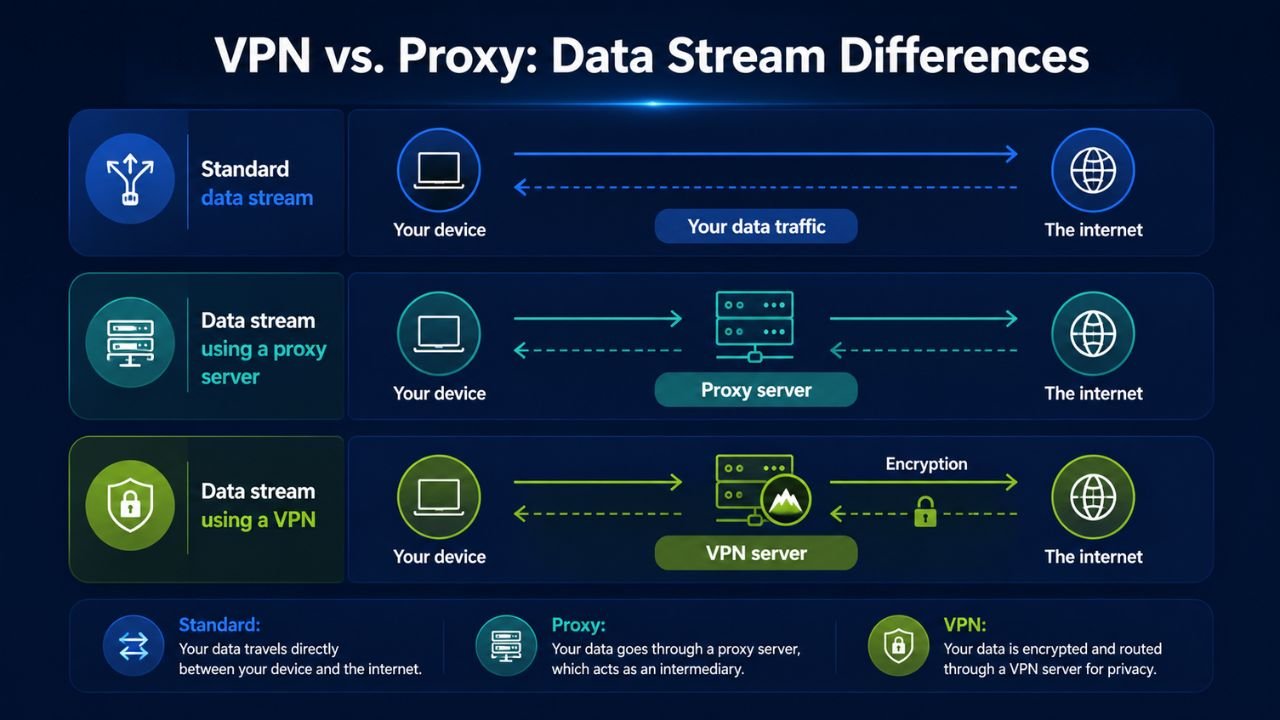
A proxy server is a server between your server and your website. It also performs the functions of a middleman, just passes your request, and sends the reply, but indicates a different IP address to the site, not yours. This is all that most proxy servers do. They cover only the surface level of your identity, but not the real data that passes between you and that middle-man server.
A VPN operates in a different way at a more intricate level. Having a connection to a VPN will form an encrypted tunnel that will enclose your entire internet connection before it even exits your device. All applications, all web browsers, and all processes running in the background on your computer enter that tunnel. The VPN server gives you a new IP address, and all that can be viewed by your ISP is encrypted noise rather than your actual activity.
How does a Proxy Server Actually Work?
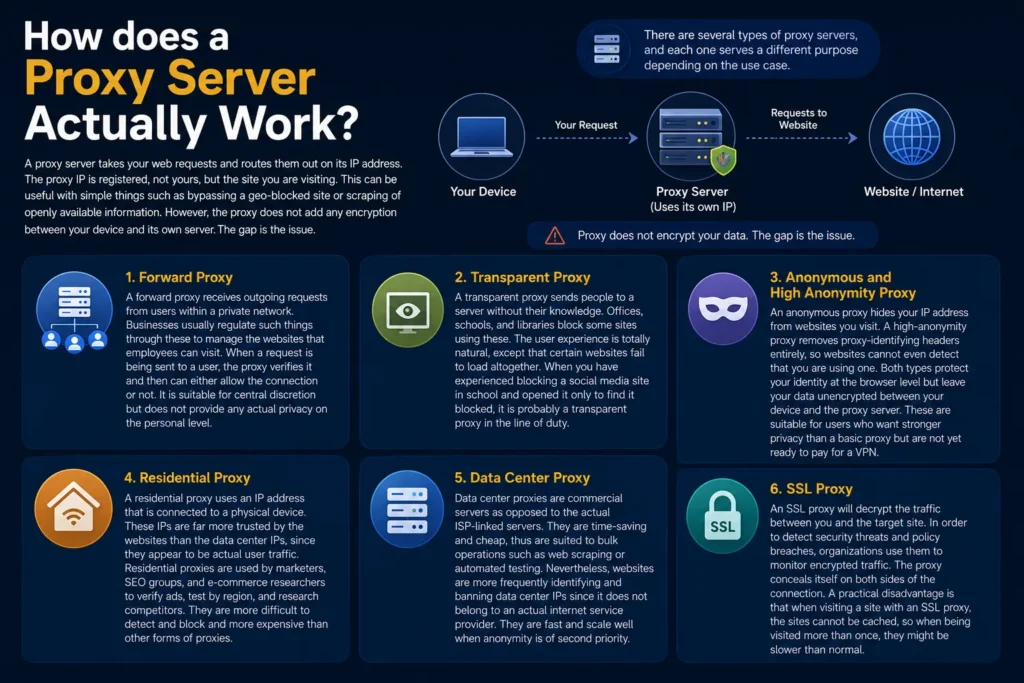
A proxy server takes your web requests and routes them out on its IP address. The proxy IP is registered, not yours, but the site you are visiting. This can be useful with simple things such as bypassing a geo-blocked site or scraping of openly available information. However, the proxy does not add any encryption between your device and its own server. The gap is the issue.
There are several types of proxy servers, and each one serves a different purpose depending on the use case.
Forward Proxy
A forward proxy receives outgoing requests from users within a private network. Businesses usually regulate such things through these to manage the websites that employees can visit. When a request is being sent to a user, the proxy verifies it and then can either allow the connection or not. It is suitable for central discretion but does not provide any actual privacy on the personal level.
Transparent Proxy
A transparent proxy sends people to a server without their knowledge. Offices, schools, and libraries block some sites using these. The user experience is totally natural, except that certain websites fail to load altogether. When you have experienced blocking a social media site in school and opened it only to find it blocked, it is probably a transparent proxy in the line of duty.
Anonymous and High Anonymity Proxy
An anonymous proxy hides your IP address from websites you visit. A high-anonymity proxy removes proxy-identifying headers entirely, so websites cannot even detect that you are using one. Both types protect your identity at the browser level but leave your data unencrypted between your device and the proxy server. These are suitable for users who want stronger privacy than a basic proxy but are not yet ready to pay for a VPN.
Residential Proxy
A residential proxy uses an IP address that is connected to a physical device. These IPs are far more trusted by the websites than the data center IPs, since they appear to be actual user traffic. Residential proxies are used by marketers, SEO groups, and e-commerce researchers to verify ads, test by region, and research competitors. They are more difficult to detect and block and more expensive than other forms of proxies.
Data Center Proxy
Data center proxies are commercial servers as opposed to the actual ISP-linked servers. They are time-saving and cheap, thus are suited to bulk operations such as web scraping or automated testing. Nevertheless, websites are more frequently identifying and banning data center IPs since it does not belong to an actual internet service provider. They are fast and scale well when anonymity is of second priority.
SSL Proxy
An SSL proxy will decrypt the traffic between you and the target site. In order to detect security threats and policy breaches, organizations use them to monitor encrypted traffic. The proxy conceals itself on both sides of the connection. A practical disadvantage is that when visiting a site with an SSL proxy, the sites cannot be cached, so when being visited more than once, they might be slower than normal.
What Is a VPN and How Does It Protect You?
A VPN or Virtual Private Network is an encrypted or private network between your computer and a single server. Anything that you send to an internet server goes through that server before it finds its destination. Encrypted information is visible to your ISP. IP address of the VPN server is visible to the websites. Anyone who attempts to spy on your connection receives gibberish.
Contemporary VPN encrypts that tunnel with protocols such as WireGuard, Open VPN, or IKEv2. These protocols deal with authentication, key exchange, and encryption in a manner that makes interception nearly impossible with state-of-the-art computing resources. It is much greater security than what any ordinary proxy server can provide.
Just like proxies, VPNs come in different forms depending on the use case. Each type serves a different audience, from individual users to large enterprises managing distributed teams.
Remote Access VPN
Remote access VPN is a type of connection between individual users and a personal network, no matter where they are. This is the most commonly used type by consumers via an app. It is also the kind that remote workers can use to connect to company systems on the road or at home in a secure manner. The user device VPN client automatically deals with the encrypted network connection.
Site-to-Site VPN
A site-to-site VPN is used as a connection between two complete networks, not the devices. This can make the two networks work as a single system within a company, which has its offices in various cities. Employees in both directions have access to the shared resources without having to install individual VPN applications on all the computers.
Corporate VPN
Corporate VPN secures employees and their devices irrespective of their location of connection. The IT teams control access centrally via the corporate VPN system. A salesman who is on the road, moving through several countries, can access internal tools safely via this local Wi-Fi setup.
VPN vs Proxy Direct Feature Comparison
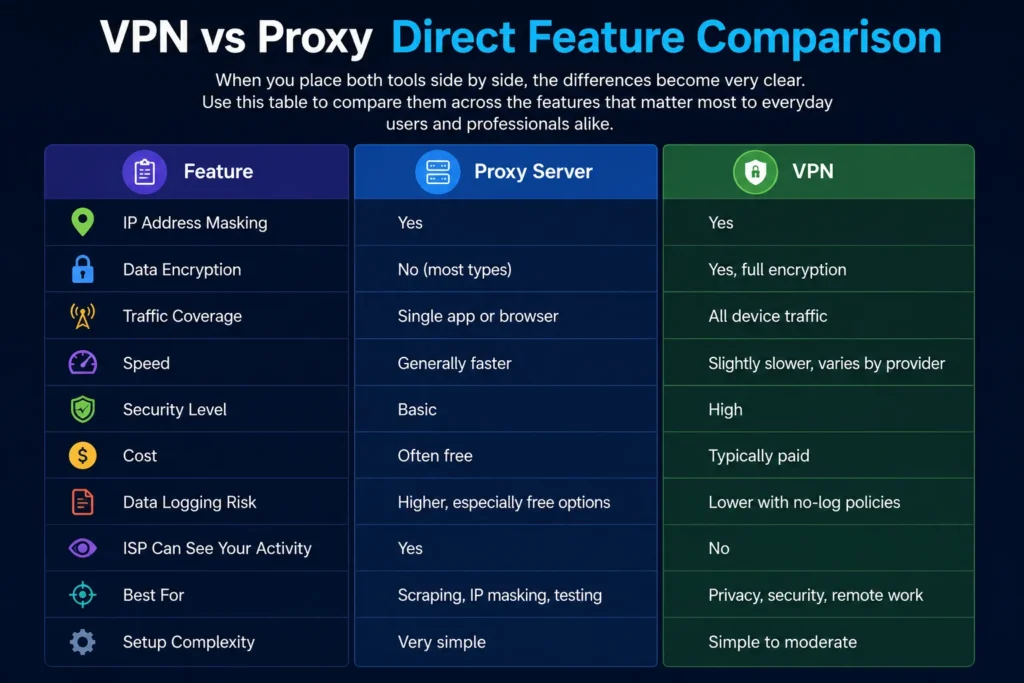
When you place both tools side by side, the differences become very clear. Use this table to compare them across the features that matter most to everyday users and professionals alike.
| Feature | Proxy Server | VPN |
| IP Address Masking | Yes | Yes |
| Data Encryption | No (most types) | Yes, full encryption |
| Traffic Coverage | Single app or browser | All device traffic |
| Speed | Generally faster | Slightly slower, varies by provider |
| Security Level | Basic | High |
| Cost | Often free | Typically paid |
| Data Logging Risk | Higher, especially free options | Lower with no-log policies |
| ISP Can See Your Activity | Yes | No |
| Best For | Scraping, IP masking, testing | Privacy, security, remote work |
| Setup Complexity | Very simple | Simple to moderate |
Real Life Example: Why Encryption Changes Everything
Here is a scenario that makes the difference very easy to understand. Consider the case that you are sitting in a coffee shop, which has an open Wi-Fi, and you have to log in to your bank account. When you access a free proxy, your banking information passes unencrypted as it flows between your laptop and proxy server. An individual within the same network using simple tools may overhear such data. The proxy has modified your IP address, and that is all; nothing has been done to safeguard the contents that you sent.
Imagine now having a VPN turned on. Once the VPN is connected, your device encrypts all the packets of information with heavy encryption. Even when he reads between your traffic on that coffee shop network, he cannot read it since it is scrambled and unreadable. The IP address of the VPN server is visible to your bank. Nothing useful is visible to your router in the coffee shop or your ISP. That would be the real-world consequences of encryption in an experience that most people encounter on a daily basis.
Privacy Differences Between VPN and Proxy
Privacy is where the gap between these two tools becomes most visible. A proxy will conceal your name from websites, but not your actions from your internet company. The visits and visit times of websites can still be monitored by your ISP. Moreover, if the proxy server logs are logged in, the operator is also able to spy on you.
VPN encrypts it all prior to leaving your device. Due to these, your ISP will only know that you are linked to a VPN server, no more. Premium VPNs update regularly audited no-log policies, meaning that not even the VPN company itself keeps logs of what you do. On the other hand, Free proxies may be monetized by capturing user logs and selling them to advertisers or data brokers.
When to Use a Proxy and When to Use a VPN
Choosing between the two tools comes down to what you actually need from them. Neither tool is universally better. Each one fits specific situations well, and using the wrong one can leave you either overpaying or underprotected.
Best Use Cases for a Proxy
- Scalable, fast scraping of large amounts of data.
- Automated testing in various geographic areas.
- Checking advertisements and their looks in diverse areas.
- To manage several accounts on sites identifying single IP traffic.
- Accessing a single geo-restricted website without paying for a full VPN
Best Use Cases for a VPN
- Using a public wi-fi in a cafe, airport, or hotel.
- Processing financial transactions or Personal information online.
- Doing work away, being able to use secure access to company systems.
- Preventing your ISP from monitoring your browsing habits
- Accessing streaming platforms reliably, since many block proxy IPs
- Protecting all apps on your device simultaneously, not just the browser
Common Mistakes People Make When Choosing Between VPN and Proxy
Some of the common mistakes that many users commit are assuming that these tools are similar solely because they conceal an IP address. The consequence of such an assumption is the presence of real security gaps, particularly in situations where individuals are using free proxy services to complete some tasks that require the provision of personal information. The second common misjudgment is that people run a VPN and a proxy simultaneously, believing that it will better protect them. In the majority of situations, this is not necessary. VPN covers all that a proxy does and includes encryption and complete coverage of the device. The combination does not often add business value in a security sense and might make your connection sluggish.
This is also a mistake that should be avoided by neglecting the jurisdiction of your VPN provider. To find out the user record, VPN firms in the data retention countries might be forced to give out the records to the authorities. Long-term protection is much more secure with providers located in jurisdictions that are privacy-friendly and have their no-log policy tested and proven.
VPN vs Proxy in Enterprise Security Settings
Companies adopting a bottom-up strategy to both tools, they do not consider them as substitutes. In the case of a big organization, a corporate VPN may be installed to enable remote workers to access internal systems without any threats. Simultaneously, the network could also apply transparent proxies or SSL proxies to monitor outgoing networks and block content based on threats and enforced content policies. These tools are never used in the same functions at the enterprise level; hence, none substitutes for the other.
In large companies, corporate VPNs are being phased out in favor of Zero Trust Network Access. This model does not provide wide access to any user after a user logs on, but it authenticates the identity and healthiness of devices every single time a user logs in to any particular application. Traditional VPNs continue to control the small and mid-size business rollouts; however, enterprise security is definitely shifting to a more granular approach.
Conclusion
What is a vpn vs proxy is not just technical. It has a direct impact on how safe your data actually is. An app or browser proxy alters the visible IP address of a particular app or browser session. A VPN not only encrypts all of your connection but also shields all the apps on your device, as well as your activity, which is not visible to your ISP or anyone attempting to steal your traffic. A proxy will be a convenient and reasonably priced choice in the case of basic IP masking or bulk data operations. To ensure privacy, security, and use in the day-to-day activities in unpredictable networks, it is evident that a VPN is a better option. Choosing the correct tool will entail knowing what you actually have under your wing, and now you have all you need to pass that verdict.
FAQs
Yes, a VPN is significantly better for privacy because it encrypts your entire internet connection and hides your activity from your ISP, while a proxy only masks your IP address without protecting the data traveling between your device and the server.
A proxy can be used to perform simple functions such as visiting geo-blocked websites or web scraping, although it is not as secure as a VPN as you are not encrypting your data and leaving your personal information unprotected to interception.
A proxy can also reduce your connection speed, particularly free/shared proxies using many simultaneous users but the delay is generally small when performing simple browsing activity in comparison to the greater burden that a VPN has to handle in its encryption process.
Running both tools simultaneously is unnecessary for most users because a VPN already covers everything a proxy does and more, including full encryption and device-wide traffic protection, so adding a proxy on top of an active VPN rarely improves security or performance.