

Salting in security is a cryptographic technique used to protect stored passwords from attacks. It involves adding a unique, randomly generated value called a salt to a password before processing it through a password-hashing algorithm. This ensures that identical passwords produce different hashes, making it harder for attackers to identify and crack multiple passwords using precomputed hash tables.
Salting is an important part of modern password security because storing hashed passwords alone may not provide sufficient protection. When combined with secure password-hashing algorithms, strong password policies, and additional authentication measures, salting helps organizations protect sensitive user credentials.
In this article, we will explain what salting in security means, how it works, its benefits, the difference between salting and hashing, and the best practices for implementing it.
What Is Salting in Security?
Salting in security refers to adding random data to a password before hashing it. The random value is known as a salt, and its primary purpose is to make password hashes unique, even when multiple users choose the same password.
For example, imagine two users create accounts using the password Hello123. Without salting, a system using the same deterministic hashing process would generate identical hashes for both users.
With salting, the system assigns each password a different random value before hashing it. Consequently, the two stored hashes will differ even though the original passwords are identical.
Salting does not encrypt passwords or make weak passwords impossible to crack. Instead, it prevents attackers from efficiently using precomputed password hashes and makes large-scale password-cracking attempts more difficult.
A salt does not need to remain secret. It is generally stored alongside the password hash so the application can verify the password when the user logs in.
How Does Password Salting Work?
Password salting works by introducing a unique random value into the password-hashing process. The application generates the salt, combines it with the password through the selected hashing algorithm, and stores the resulting hash.
Step 1: User creates a password
Example: Hello123
Step 2: Generate a unique salt
Example: a8K2mP7x
Step 3: Apply a password-hashing algorithm
Password + salt → Argon2id or another suitable algorithm
Step 4: Store the password hash
Save the encoded hash and the information needed to verify it.
The process follows these steps:
- Generate a salt: The application creates a unique random value using a cryptographically secure random number generator.
- Combine the password and salt: The selected password-hashing algorithm processes the password with the salt.
- Generate the hash: The algorithm produces a derived value that can be used to verify the password later.
- Store the result: The system saves the encoded password hash, which commonly contains the salt and algorithm parameters.
- Verify during login: The application uses the submitted password and the stored verification information to check whether the password is correct.
A fresh salt should be generated whenever a new password hash is created, including after a password change or reset.
Why Is Salting Important in Cybersecurity?
Salting strengthens password storage by reducing the effectiveness of several common password-cracking techniques.
1. Prevents Rainbow Table Attacks
Rainbow tables are precomputed collections of password-hash relationships that attackers can use to identify passwords from stolen hashes.
Without salting, attackers may compare stolen hashes against existing tables and quickly discover common passwords. A unique salt changes the input to the hashing algorithm, making precomputed tables for unsalted passwords ineffective against the salted hashes.
2. Protects Against Duplicate Password Hashes
Users frequently choose the same passwords. Without unique salts, identical passwords processed by the same algorithm and parameters produce identical hashes.
Salting makes these hashes different. As a result, attackers cannot immediately identify all accounts sharing the same password simply by comparing their stored hash values.
3. Makes Large-Scale Password Cracking More Expensive
When a database contains thousands or millions of password hashes, attackers may attempt to crack them in bulk.
Unique salts prevent attackers from reusing one set of precomputed results across all those accounts. They must account for each salt when testing password guesses, increasing the work required to attack the database.
4. Improves Protection Against Precomputed Dictionary Attacks
Dictionary attacks use lists of common passwords and likely variations. Salting prevents attackers from directly matching salted hashes against precomputed hashes of those passwords.
However, salting does not eliminate dictionary attacks. If an attacker obtains the hashes and salts, they can still test likely passwords against individual accounts. A suitable password-hashing algorithm is therefore essential.
Salting vs. Hashing vs. Encryption
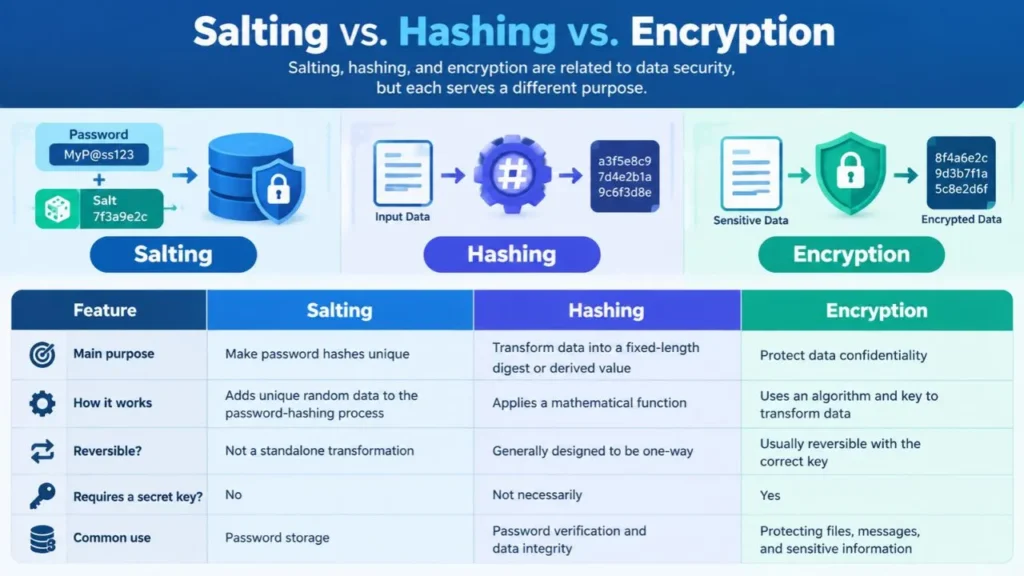
Salting, hashing, and encryption are related to data security, but each serves a different purpose.
| Feature | Salting | Hashing | Encryption |
| Main purpose | Make password hashes unique | Transform data into a fixed-length digest or derived value | Protect data confidentiality |
| How it works | Adds unique random data to the password-hashing process | Applies a mathematical function | Uses an algorithm and key to transform data |
| Reversible? | Not a standalone transformation | Generally designed to be one-way | Usually reversible with the correct key |
| Requires a secret key? | No | Not necessarily | Yes |
| Common use | Password storage | Password verification and data integrity | Protecting files, messages, and sensitive information |
Hashing transforms data, while salting changes the input to the password-hashing process. Encryption, by contrast, allows authorized users or systems to recover the original information using the appropriate key.
For password storage, organizations should generally use a dedicated password-hashing algorithm with a unique salt rather than storing passwords in plain text or relying on reversible encryption.
Best Practices for Password Salting
Organizations should follow these best practices to implement salting effectively and protect stored credentials.
1. Generate a Unique Salt for Every Password
Every password hash should use a unique, randomly generated salt. Reusing the same salt across all accounts allows attackers to compare password hashes and reuse cracking work more efficiently.
A new salt should be generated whenever a password hash is created or regenerated.
2. Use a Cryptographically Secure Random Number Generator
Salts should be generated using a cryptographically secure random number generator rather than predictable values such as usernames, email addresses, timestamps, or manually selected strings.
A common practical choice is a 16-byte random salt, although the appropriate requirements depend on the algorithm and implementation.
3. Choose a Secure Password-Hashing Algorithm
Salting must be combined with an algorithm designed specifically for password storage. Recommended options include:
- Argon2id: A strong default for new applications because it uses both memory and computation to make password cracking more expensive.
- scrypt: A memory-intensive alternative when Argon2id is unavailable.
- bcrypt: A widely used option for existing applications and compatible systems.
- PBKDF2: An established alternative that can be appropriate when compliance requirements dictate its use.
Avoid using fast general-purpose hashing algorithms such as SHA-256 or MD5 alone to store passwords. Their speed makes it easier for attackers to test large numbers of password guesses.
4. Store the Salt Alongside the Password Hash
A salt is not a password or secret key. It can generally be stored in plain text alongside the password hash.
Many modern password-hashing libraries encode the salt, algorithm identifier, and relevant cost parameters directly into the stored hash string. Developers should use the library’s verification function rather than implementing their own password-comparison process.
5. Never Store Passwords in Plain Text
Even with salting, storing original passwords in a database creates an unnecessary security risk. If the database is compromised, plain-text passwords can be exposed immediately.
Applications should store password hashes produced by secure password-hashing functions and restrict access to authentication data.
6. Consider Using a Pepper as an Additional Layer
A pepper is a secret value used in addition to a salt. Unlike a salt, it should remain confidential and be stored separately from the password database, such as in a secrets manager or hardware security module.
A pepper can provide additional protection if an attacker steals only the password database. However, it requires careful key management and does not replace unique salts or a suitable password-hashing algorithm.
What Are the Limitations of Salting?
Although salting is an essential security practice, it does not guarantee complete password protection.
- Weak passwords can still be cracked: Attackers can test common passwords against individual salted hashes.
- Stolen hashes can still be attacked offline: If attackers obtain both the hashes and salts, they can continue guessing passwords without interacting with the original website.
- Fast hashing algorithms remain vulnerable to rapid guessing: Salting does not make an unsuitable algorithm such as plain SHA-256 appropriate for password storage.
- Password reuse remains dangerous: If users reuse a compromised password on another website, salting cannot prevent attackers from trying that password elsewhere.
- Other security controls are still necessary: Multi-factor authentication (MFA), login rate limiting, secure database access, and monitoring can reduce additional risks.
The most effective approach is to combine unique salts with a modern password-hashing algorithm, strong user passwords, and appropriate authentication controls.
Conclusion
Salting in security is an essential technique for protecting stored passwords against common password-cracking attacks. By adding a unique, randomly generated value to each password before hashing, it prevents identical passwords from producing identical stored hashes and makes precomputed rainbow-table attacks far less effective.
However, salting alone is not enough. Organizations should combine unique salts with secure password-hashing algorithms such as Argon2id, scrypt, or bcrypt, and implement additional safeguards such as multi-factor authentication and secure database access.
Ultimately, effective password security depends on using the right combination of cryptographic techniques and following established security best practices.
Read More:
- Is Etsy Legit and Safe? Everything You Need to Know Before Buying
- What Is a CAPTCHA Challenge Response? How It Works and Why Websites Use It
- Is DuckDuckGo Safe? Privacy, Security, Google Comparison, Owner, Pros & Cons Explained
Frequently Asked Questions
Salting is a security technique that adds unique, random data to a password before hashing it. This makes identical passwords produce different stored hashes and reduces the effectiveness of precomputed password-cracking attacks.
The main purpose of salting is to make password hashes unique and prevent attackers from efficiently using precomputed hash tables to crack multiple passwords.
Salting and hashing are not competing methods. They work together: hashing transforms the password into a derived value, while salting introduces unique random data that strengthens password storage.
No. A salt is generally stored alongside the password hash. Its security benefit comes from being unique and randomly generated, not from being hidden.
Argon2id is a strong default for new applications. Scrypt and bcrypt are alternatives, while PBKDF2 can be suitable for systems with specific compliance requirements. The algorithm and its parameters should be configured according to current security guidance.
Yes. Attackers can still guess passwords and calculate their hashes using the corresponding salts. Salting makes precomputed attacks less effective, while slow, memory-intensive password-hashing algorithms increase the cost of each guessing attempt.